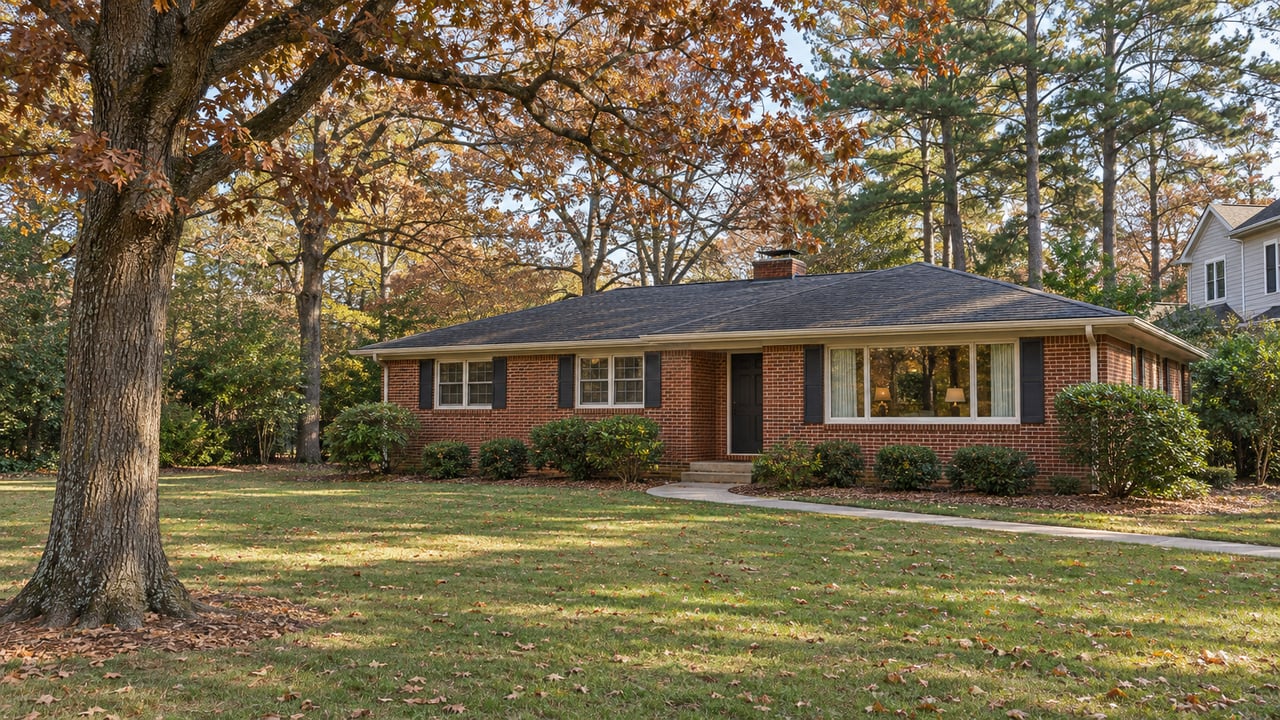
On Feb. 23, 2026, a photographer for The News & Observer found a two-story house going up on Duke Road in Quail Ridge, much taller than the ranch homes on either side. The same day a compact track loader and a backhoe were working the lot at 7817 Audubon Drive in North Raleigh, where the original house had already been torn down. On Ravenhurst Drive, a home still under construction had already sold.
In streets like these, the house on an established lot competes with a builder's plan for that lot as much as with the ranch next door. If you are a move-up buyer weighing an older North Raleigh home against new construction farther out, that builder plan is your real competition, and it shapes your decision more than the median price on any portal.
Raleigh's demolitions more than doubled in one year
The city recorded 252 demolitions in calendar year 2025, according to the same N&O report. That compares with 124 in 2024 and 105 in 2023. Raleigh Planning Director Pat Young told the paper that not every demolition was a teardown, but most were.
Young described the buyer's side this way: "Fundamentally what's happening here is someone buying a home has three options. Leave it and buy it 'as is,' they can rehabilitate it or modernize it, or they can tear it down and replace it. And I think what we see is it really is a matter of economics."
Those three options matter because every bidder on an older house has them, and not every bidder values them the same way. A family planning to live in the ranch as it stands prices the first option. A buyer planning a renovation prices the second. A builder prices the third, working backward from what a finished new house on that street will sell for. In 2025 the third option won often enough to more than double the count from 2024.
Why a 1960s ranch now looks like land to a builder
Paul Kane, CEO of the Home Builders Association of Raleigh-Wake County, gave the N&O the supply-side reasons. Raleigh grew fast in the 1960s and 1970s after Research Triangle Park was built, and many homes from that period have reached the end of their life cycle, especially those never heavily renovated. He added that a major repair or renovation can require a homeowner to bring the entire house up to code, and that cost can push the math toward starting over.
Kane also named land as the larger constraint. "The scarcity of land becomes an enormous factor in the economics, in the availability and whether or not it makes sense to tear down a house in a part of town you love, versus maybe having to move out of county because there's just not much good developable land in Wake County anymore," he said.
Jennifer Truman, an architect who advocates for additional housing, called it "development math" in the same article. She pointed out that a project's numbers involve many players besides the builder. Lenders, underwriting, construction materials and the prices of nearby single-family homes all feed into the cost of the finished house.
For a buyer, this means the age of an older ranch now works in two directions. It lowers what an owner-occupant will pay for the house as it stands, and it raises the chance that a builder sees the lot as worth more empty. The asking price you see sits somewhere between those two valuations.
The finished house sets the ceiling
The far end of the builder's math is the price of the new house, and the city has put a figure on it. Young told the N&O that a brand-new single-family home inside the Beltline averages about $1 million to $1.1 million.
North Raleigh has its own markers. The newly built home at 7509 Haymarket Lane was listed at $1.75 million and had sold by the time the N&O photographed it in February. The house on Ravenhurst Drive sold before it was finished. When new houses on nearby streets sell at those prices, the land under an aging ranch a few blocks away is worth more to a builder. A move-up buyer who wants to live in that ranch, or renovate it, pays for that too.
The top of the market follows the same pattern. A May 2026 Triangle Business Journal report found that North Ridge, in North Raleigh, had both of the city's most expensive listings at the time, at $9.5 million and $8.5 million, and that interest in the neighborhood had surged over the previous eight to 10 years.
Inside the Beltline in Hayes Barton, the N&O reported in May 2026 that construction was underway on The City Homes at Birney Park, at Fairview and Oberlin roads. The project is eight residences of up to 4,900 square feet from Raleigh-based developer Beacon Street, starting around $3.5 million and expected to deliver in late 2027. Two of the eight had been reserved at the time of the report. Birney Park's first phase, The Brightbury condominium building, starts at $1.8 million. In the same article, the N&O cited DoorifyMLS data showing a Triangle median single-family sale price of $439,000 in April 2026.
Taken together, these numbers show how wide the gap can be. In an established neighborhood, the gap between what a lot's current house is worth and what a new house on that lot could sell for is often several hundred thousand dollars, and at the high end it can run into the millions.
Not every older house ends up in a dumpster
Some neighborhoods and owners have taken a different route. Forest Park, a historic neighborhood near the Village District and downtown, has a Neighborhood Conservation Overlay District. A longtime resident told the N&O that the overlay led neighbors, city staff and new owners to a two-home plan for one lot that all sides accepted.
Raleigh Magazine covered the same pressure on the city's modernist homes in June 2026. The "Potato Chip House" was demolished, while the Weber House was moved and restored.
Some teardowns lead to more homes on the lot. Young said that since the city's missing-middle changes, Raleigh has seen "a huge increase" in side-by-side two-unit townhomes priced around $550,000 to $700,000. He added that the city does not yet have enough data to tell whether those rules are reducing teardowns, and that "we don't want to accelerate or encourage teardowns for sure." In Hayes Barton, the 1925 house at 908 Williamson Drive was demolished for a 17-townhome project. By December 2025, the N&O reported, site work was underway.
For a buyer, these cases matter for one reason. The rules and history of a particular street affect how much a builder can do with a lot, and so they affect how hard the builder bids against you.
The other side of the math is a drive north
Truman described the choice facing the whole region in plain terms: "The choice is do we tear down and change incrementally (on) lots one at a time within the city, or do we sprawl? Do we go out to Clayton? Do we go out to Johnston County? Do we go out to Garner and build whole neighborhoods where we replace whole farms and we replace thousands of trees?"
Households make the same choice one at a time. A move-up buyer can compete with builders for an older lot close to Raleigh's core, or buy where the land is still being turned into new neighborhoods. North of Raleigh, that second path runs through Wake Forest, Rolesville and Youngsville.
Countywide figures put that choice in context. Wake County reported a median sale price of $475,000 for October 2026, and the county notes that its small number of very large transactions has virtually no effect on that median. Set beside Young's figure of about $1 million for a new house inside the Beltline, that median shows how much of an established-Raleigh price is paying for location and land.
On the calendar, Wake County's next countywide revaluation takes effect Jan. 1, 2027, and the county's revaluation page says the results go to the Board of Commissioners on Jan. 19, 2027, with notices mailed that same week.
Questions I hear about older Raleigh homes
Does a teardown on my street raise my home's value? It changes who might bid on your home. Once builders are active nearby, a builder pricing a new house is part of the buyer pool alongside families who want to live in the house as it stands. How much that adds depends on your lot and what can be built there. A home valuation built on recent nearby sales is the place to start.
Is a new-build in the suburbs cheaper than renovating an older Raleigh house? Sometimes, but the comparison has to include the land. When you renovate an older Raleigh house, you are paying for a lot close to the core, and suburban new construction usually sits on land that was a farm a few years earlier. My buyer resources cover how I set up that comparison.
I'm a CPA as well as a broker, so I look at an older North Raleigh house as a lot with a house on it and run the numbers both ways. If you're deciding whether to keep, renovate or sell an older ranch, or you're weighing one against new construction in Wake Forest or Rolesville, call me and I'll put the numbers side by side for your situation. Alexander Realty, LLC is just me, so you'll talk with me directly from the first call to closing.